Chelsea vs. Bayern Munich: Tactical Lessons from a European Classic
he 2012 Champions League final remains the most vivid Chelsea vs. Bayern Munich encounter—a night when defensive resilience and set-piece drama overturned possession stats. Chelsea absorbed 35 shots across 120 minutes in Munich and still lifted the trophy. That match wasn't an outlier;it defined the psychological template for this fixture. When these two meet, the game often becomes a test of how much control one side can trade for cutting edge.
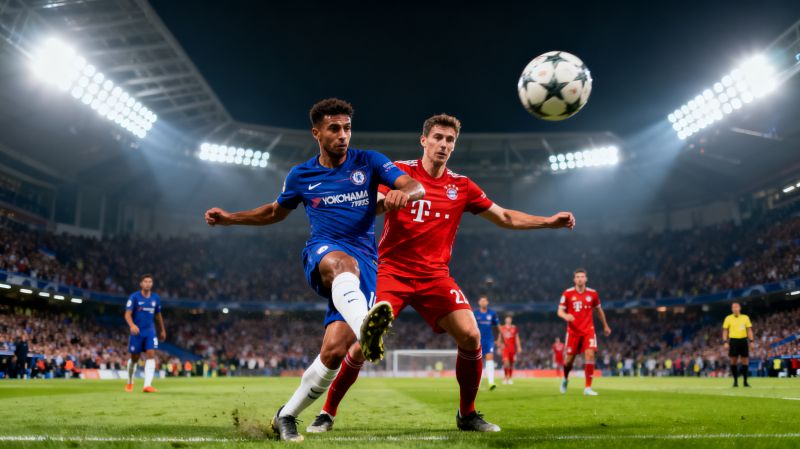
Bayern's default approach is territorial suffocation. Their full-backs push high, midfielders rotate into half-spaces。and the opposition is pinned into a low block. Chelsea's best responses have historically come from compact 5-4-1 shapes and direct transitions through a physical striker. In the 2012 final, Didier Drogba's hold-up play and Chelsea's willingness to defend deep turned Bayern's dominance into frustration. The pattern repeated in the 2020 round of 16, though Bayern's 7-1 aggregate win exposed how brittle Chelsea's rebuild was at the time. That tie was less about tactics and more about a squad mismatch—Bayern's press shredded a Chelsea back line missing experience.Watch the midfield pressing triggers. Bayern's Joshua Kimmich and Leon Goretzka love to jump into the opposition's first pass, but that aggression leaves a pocket behind them. Chelsea's best chance in any Chelsea vs. Bayern Munich game is to bypass the first press with a clipped ball into the channel. Mason Mount's movement between the lines caused Bayern problems in 2020 even as the scoreline spiraled. On the flip side, Bayern's wide overloads—Alphonso Davies or Noussair Mazraoui combining with a winger—force Chelsea's wing-backs into two-on-one defending. That's where Chelsea's discipline breaks: one missed recovery run and the far post is open.Set pieces decide these matches more than open play. Chelsea have scored from corners in three of their last four meetings with Bayern across all competitions。including the 2012 final. Bayern's zonal marking has a known weak spot at the near post, and Chelsea's tall center-backs—Antonio Rüdiger in the past, now Levi Colwill—target that zone. It's a small detail, but it's the kind of edge that flips a tight game. Bayern's own threat comes from second balls after cleared corners;their midfielders camp on the edge of the box and recycle quickly.
What makes Chelsea vs. Bayern Munich compelling isn't just the history. It's the stylistic clash: patient possession against reactive counter-punching. Bayern will dominate the ball—usually 60% or more—but Chelsea have shown they can win without it. The key variable is whether Chelsea's back three can stay compact for 90 minutes and whether their forward can hold the ball under pressure. When those two things happen, this fixture tilts toward chaos, and chaos favors the underdog. When they don't, Bayern's quality turns the game into a procession. That tension is why neutral fans should pay attention.
Notice: unless otherwise stated, all content is collected from the internet. If it infringes your rights, please contact us for removal.